Hovee’s Auto Body & Paint helps drivers restore their vehicles after accidents, dents, and collision damage with professional auto body repair and painting services.



Find certified collision repair shops serving Simi Valley and the surrounding Ventura County area.
Collision repair in Simi Valley covers everything from minor fender damage to full structural restoration after a serious crash. Shops here work with all major insurance carriers and can handle the makes and models common to this suburban commuter community. Whether the damage happened on the 118 Freeway or in a parking lot near the Simi Valley Town Center, local providers can assess and restore your vehicle.
Collision repair is the process of returning a vehicle to its pre-accident condition through structural, mechanical, and cosmetic work — including frame straightening, panel replacement, paint matching, and refinishing. In Simi Valley, where the median household income sits near $95,800 and many residents drive newer model vehicles as part of daily commutes to Los Angeles, quality repairs that preserve manufacturer warranties matter. The city's elevation, canyon-adjacent roads like Rocky Peak Road, and high-volume corridors such as the Ronald Reagan Freeway (SR-118) all contribute to the types of collision scenarios local shops regularly handle. Damage from rear-end highway incidents, sideswipes on Tapo Canyon Road, and multi-vehicle freeway backups are among the most common repair situations in this part of Ventura County.
Collision repair is a broad category that goes well beyond cosmetic fixes. Certified shops in Simi Valley perform full structural assessments using computerized measuring systems, ensuring that a vehicle’s frame geometry meets manufacturer specifications before any surface work begins.
Simi Valley’s position as a bedroom community roughly 35 miles from Downtown LA means a large share of residents are daily freeway commuters. That puts consistent wear on vehicles and increases exposure to high-speed collision scenarios along the SR-118 corridor. The surrounding terrain — including the Santa Susana Mountains and canyon-adjacent residential streets — also creates road geometry that contributes to single-vehicle incidents and rollover risks less common in flat urban grids.
The city’s housing stock skews toward single-family homes built during the 1960s and 70s suburban expansion, and many households own multiple vehicles. That makes finding a reliable, local collision center a practical priority rather than an occasional need.
Shops operating in this market are familiar with the insurance providers most common among Ventura County residents and can often handle direct repair program (DRP) work, which streamlines the claims process significantly.
Providers listed here serve neighborhoods throughout Simi Valley’s 41.5 square miles, including areas near the Ronald Reagan Presidential Library, Knolls neighborhood, and Wood Ranch. Learn more about local automotive services available across Simi Valley.
Understanding when to call an expert can save you time, money and prevent bigger problems down the line.
Not every situation that requires collision repair is obvious at first. Some structural damage is invisible to the naked eye but affects handling, safety systems, and long-term vehicle integrity.
Delaying collision repair can allow hidden damage to worsen, reduce resale value, and in some cases compromise safety features like crumple zones and sensor-equipped bumpers. Explore the full range of auto body services available through this directory to find the right type of provider for your situation.
Hovee’s Auto Body & Paint helps drivers restore their vehicles after accidents, dents, and collision damage with professional auto body repair and painting services.
Signs You Need This Service
Visible Panel Damage or Misalignment
Dents, creases, or gaps between body panels that weren't there before a collision are a clear indicator that repair work is needed. Even cosmetic-looking damage can hide deeper structural issues underneath.
Doors or Trunk Won't Close Properly
When a door, hood, or trunk lid requires extra force or doesn't latch cleanly after a collision, the body frame may have shifted. This is a structural concern that goes beyond cosmetic repair.
Deployed Airbags
Airbag deployment signals that the vehicle absorbed a significant impact force, and the restraint system must be fully reset and inspected by a certified shop before the vehicle is safe to drive.
Vehicle Pulling or Handling Changes
Pulling to one side, vibration at highway speeds, or unusual steering behavior after a crash can indicate frame damage or suspension component displacement requiring immediate professional evaluation.
Cracked or Bubbling Paint Along Impact Areas
Paint that cracks or separates following a collision exposes bare metal to the elements, and in Simi Valley's dry heat and Santa Ana wind conditions, surface rust can begin forming quickly if left untreated.
Warning Lights After a Collision
Modern vehicles have sensors embedded in bumpers, mirrors, and body panels that can be disrupted by impact. Dashboard warnings for ADAS, parking sensors, or lane-keep systems often indicate collision-related sensor damage.
Repairs that require frame or unibody straightening involve more labor hours and specialized equipment than surface-level panel work. Structural repairs are among the most significant cost drivers in any collision job.
Luxury vehicles, late-model trucks, and EVs typically require manufacturer-specific parts and certified repair procedures that add to overall cost. Older vehicles may have limited parts availability, affecting both price and turnaround time.
Multi-stage, pearl, or custom paint finishes require more blending and refinishing work than standard single-stage colors. The more panels affected, the more complex the color-matching process becomes.
Using original equipment manufacturer parts rather than aftermarket alternatives generally increases repair costs but may be required to maintain manufacturer warranties or insurance agreements.
Vehicles equipped with advanced driver assistance systems — increasingly common among Simi Valley's newer suburban vehicle stock — often require sensor recalibration after any repair affecting bumpers, windshields, or body panels.
The terms of a driver's collision coverage, including deductible amount and any direct repair program requirements, directly affect out-of-pocket costs and which shops are eligible to perform the work.
A certified technician inspects the vehicle — both visually and with computerized measurement tools — to identify all damage, including hidden structural issues not visible from the surface. A written estimate is produced before any work begins.
Most Simi Valley shops work directly with insurance adjusters to align the repair estimate with the approved claim, reducing back-and-forth for the vehicle owner and clarifying what is covered.
Once a repair order is approved, technicians disassemble the affected areas to expose all damage. This step often reveals additional impact damage that wasn't visible during the initial exterior assessment.
Frame straightening, panel replacement, and any mechanical repairs — such as suspension or cooling system damage — are completed first, as all subsequent work depends on restoring correct geometry and function.
Repaired or replaced panels are shaped, filled as needed, and sanded to create a smooth surface ready for primer and paint. This step requires precision to ensure seamless blending with surrounding body lines.
Using computerized color-matching systems, painters apply primer, base coat, and clear coat in a controlled environment to match the vehicle's original finish. Multi-stage finishes common on newer models require additional refinishing steps.
All components are reinstalled, sensors are recalibrated as needed, and the vehicle undergoes a full quality check — including panel alignment, paint inspection, and a road test — before it is returned to the owner.
This site is a directory of local service providers. Pricing, processes, timelines, and recommendations vary by company. Always confirm details directly with your chosen provider before proceeding.
Professional paint matching helps restore your vehicle’s appearance and protects long-term resale value after an accident. Modern paint systems are highly complex, especially with metallic and pearl finishes. Accurate paint blending and refinishing help ensure repaired panels match the surrounding factory finish properly.
Drivers should look for collision repair shops with strong reviews, experienced technicians, advanced repair equipment, insurance claim assistance, structural repair capabilities, and clear communication. Modern vehicles require specialized repair procedures and safety system calibrations, making professional experience extremely important after an accident.
Yes. California drivers generally have the legal right to choose their own collision repair shop after an accident. Insurance companies may recommend preferred repair facilities, but vehicle owners can select the shop they trust for repairs. Choosing an experienced collision repair facility helps ensure proper structural repairs, paint matching, and safety system calibration after an accident.
Collision repair estimates can vary because each shop may inspect damage differently, use different labor rates, recommend different repair methods, or identify different levels of hidden damage. Parts selection, paint materials, structural repair needs, and insurance requirements can also affect pricing. A lower estimate is not always better if it leaves out important repairs or safety-related work.
Yes. Even low-speed accidents can create hidden damage underneath visible body panels. Modern vehicles contain structural supports, sensors, brackets, and safety systems that may be affected during a collision. Professional inspections help identify hidden damage before it leads to larger safety or drivability issues later.
A collision repair estimate usually includes visible damage inspection, labor, replacement parts, paint materials, refinishing work, structural repairs, and sometimes diagnostic scans or safety system calibration. The first estimate may not include hidden damage because some issues are only discovered after vehicle disassembly. Supplemental estimates may be needed later.
Collision repair timelines may change because hidden damage is often discovered after technicians disassemble the vehicle. Insurance approvals, parts availability, paint curing time, structural repairs, and safety system calibrations can also affect the repair schedule. Modern vehicles require more detailed repair procedures than older cars due to advanced technology and safety systems.
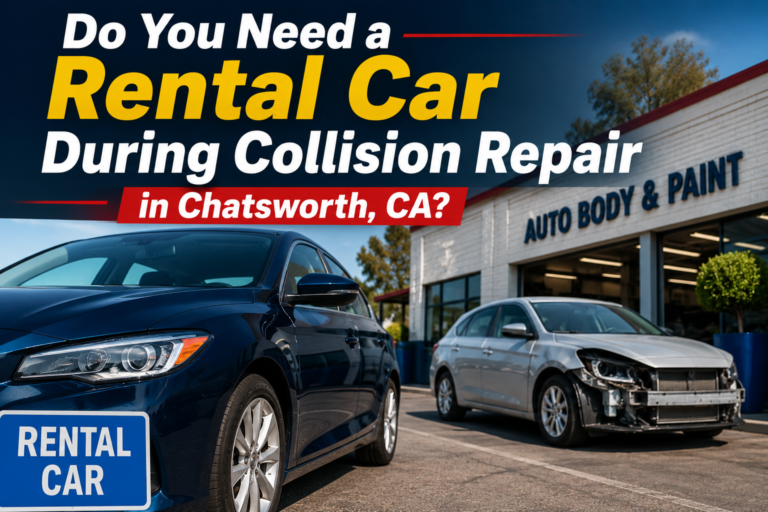
After an accident, many drivers focus immediately on the visible damage to their vehicle. But once repairs begin, another major question quickly comes up: “How am I going to get around while my car is in the shop?” For drivers researching collision repair in Chatsworth, understanding how rental cars work during the repair process can […]
Read Article →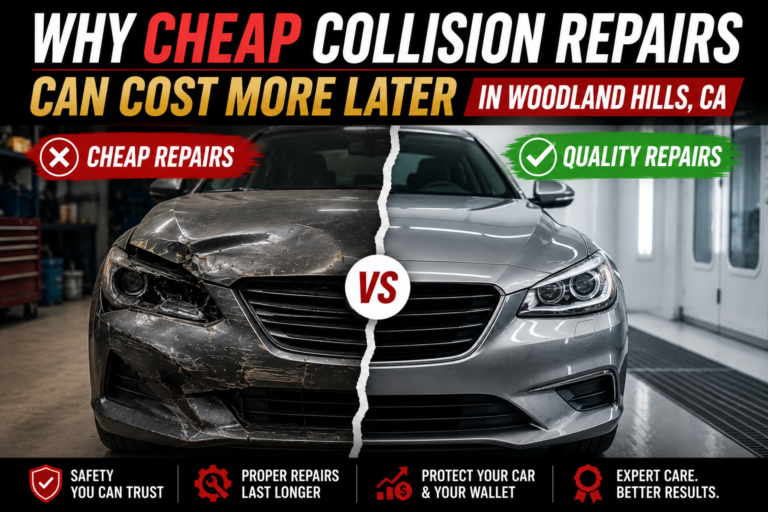
After an accident, many drivers immediately start comparing repair estimates. That is understandable. Collision repairs can feel unexpected and stressful, especially when dealing with insurance claims, rental vehicles, and daily transportation needs. However, choosing the cheapest repair option is not always the smartest long-term decision. For drivers researching collision repair in Woodland Hills, understanding the […]
Read Article →
After a vehicle is repaired following an accident, many drivers assume the process is complete the moment they pick up their keys. However, one of the most important steps in modern collision repair actually happens at the very end: the post-repair inspection. For drivers researching collision repair in Canoga Park, understanding the importance of post-repair […]
Read Article →Browse local collision repair providers across Simi Valley and Ventura County — from shops near the SR-118 corridor to those serving Wood Ranch and beyond — and get connected to certified professionals who understand this community's roads and driving conditions.