Hovee’s Auto Body & Paint helps drivers restore their vehicles after accidents, dents, and collision damage with professional auto body repair and painting services.
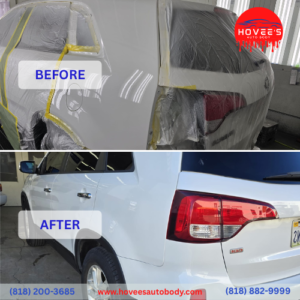


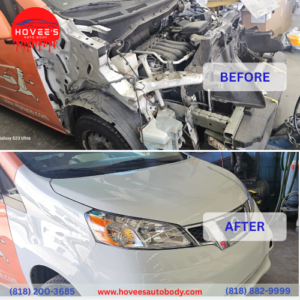

Connect with local bumper repair specialists who know Calabasas roads and high-end vehicle needs.
Calabasas drivers searching for bumper repair can find qualified local shops through this directory — from minor scuffs picked up on Mulholland Highway to more serious collision damage sustained on the 101 Freeway interchange near Lost Hills Road. Given the city's concentration of luxury and late-model vehicles, shops serving Calabasas routinely work with OEM parts, advanced paint-matching systems, and manufacturer-approved procedures. Use this directory to connect with providers who handle both cosmetic touch-ups and full bumper replacements.
Bumper repair covers the diagnosis, restoration, or replacement of a vehicle's front or rear bumper assembly — including the fascia, reinforcement bar, absorber foam, sensors, and finish coat. In Calabasas, where the median household income exceeds $157,000 and driveways commonly hold European luxury marques and late-model SUVs, quality of repair matters as much as speed of turnaround. The winding canyon roads connecting Calabasas to Topanga, Malibu, and the San Fernando Valley — including stretches of Old Topanga Canyon Road and Mulholland Highway — create consistent exposure to low-speed impacts, tight turns, and parking-lot contact near commercial centers like The Commons. Shops in and around Calabasas typically stock or source OEM-spec components to meet the expectations of drivers whose vehicles carry significant replacement value.
Bumper repair is not a single procedure — it ranges from sanding and repainting a scuffed fascia to fully replacing a crumpled front assembly that includes radar sensors for adaptive cruise control. In Calabasas, where many vehicles are equipped with advanced driver-assistance systems (ADAS), a bumper replacement often requires recalibrating sensors behind the fascia to restore proper function. Shops that serve this market are typically equipped for that additional step.
The daily commute from Calabasas toward the 101 Freeway — or the slower, curvier drive down Old Topanga Canyon Road toward the coast — each carry their own risk profile. Freeway on-ramp merges near the Valley Circle interchange, tight parking at The Commons at Calabasas, and the narrow canyon shoulders near Creekside Park and Mulholland Highway all contribute to the bumper damage patterns that local shops see regularly.
A qualified technician will assess whether the bumper fascia, reinforcement bar, and energy absorber can be restored or need to be replaced outright. Minor cracks and surface scratches are often repairable with filler, sanding, and a blended repaint. Significant structural deformation — especially on vehicles where the bumper houses parking sensors or a backup camera — typically calls for full replacement to ensure both appearance and safety system integrity.
For a broader look at what auto body services are available to Calabasas residents, explore the full city directory. Local providers are listed with contact details, service categories, and customer reviews to help you compare before you call.
Understanding when to call an expert can save you time, money and prevent bigger problems down the line.
Not every bumper issue is obvious at first glance. Some damage — particularly to the reinforcement bar or sensor housing behind the fascia — is invisible until a technician removes the cover. Calabasas drivers whose vehicles are newer or higher-value should be especially cautious about assuming a bump is purely cosmetic.
Consider reaching out to a local bumper repair specialist when:
Bumper damage left unaddressed can lead to moisture intrusion, electrical issues with sensor wiring, and failing a vehicle inspection. The auto body industry encompasses both cosmetic and structural repair services, and many shops also coordinate directly with insurers to simplify the claims process.
Hovee’s Auto Body & Paint helps drivers restore their vehicles after accidents, dents, and collision damage with professional auto body repair and painting services.
Signs You Need This Service
Visible Cracking or Deep Scuffs on the Fascia
Surface cracks and deep paint gouges won't improve on their own and can allow moisture to reach the bumper's internal structure. This is the most common reason Calabasas drivers seek repair after parking-lot or low-speed incidents.
Bumper Is Misaligned or Sagging
If the bumper has shifted away from the body panels or droops at one corner, the mounting brackets or clips may be broken. Left uncorrected, a loose bumper can detach at freeway speeds on the 101.
Parking Sensors or Backup Camera Acting Erratically
An impact that appears minor can displace or crack sensor housings embedded in the bumper fascia. Erratic alerts or a distorted camera image after a collision are signs that a technician should inspect the assembly.
Paint Transfer or Scuffing from Another Vehicle
Contact with another bumper in a crowded parking area often leaves paint transfer that obscures whether the plastic underneath is also damaged. A proper inspection will determine if refinishing alone is sufficient or if structural repair is needed.
Bumper Feels Soft or Gives Unusual Flex
A healthy bumper assembly is rigid. Unusual softness or flex typically indicates that the energy absorber foam behind the fascia has compressed or cracked, and that component usually needs replacement.
Minor cracks and paint scuffs can often be restored at significantly lower cost than a full bumper assembly swap. The technician's assessment of structural integrity determines which path is appropriate.
Many Calabasas vehicle owners — who tend to drive luxury and late-model imports — request OEM parts to preserve warranty coverage and resale value, which typically increases parts costs compared to aftermarket alternatives.
Vehicles equipped with parking sensors, blind-spot monitors, or radar-based ADAS features behind the bumper require recalibration after replacement, adding labor time and specialized equipment to the total cost.
Luxury and premium vehicles often use multi-stage paint systems — including matte, tri-coat, or color-shift finishes — that require more precise mixing and blending, increasing refinishing labor and material costs.
What looks like a surface scuff may conceal damage to the reinforcement bar or mounting hardware. Discovering hidden damage during disassembly adds repair scope and cost beyond the initial estimate.
Filing through an insurance carrier introduces an adjuster review process that can affect which parts and procedures are approved, and may require supplemental documentation from the shop if additional damage is found.
A technician examines both the visible fascia and the components behind it — reinforcement bar, absorber, sensor housings, and mounting points — to determine the true scope of damage before preparing an estimate.
The shop provides a written estimate specifying OEM or aftermarket parts, labor hours, and refinishing requirements. Parts are ordered and lead times confirmed before scheduling the repair.
The bumper fascia is removed to access the reinforcement bar and energy absorber. Bent or cracked structural components are repaired or replaced at this stage.
If the plastic fascia is repairable, technicians fill, sand, and prime it before refinishing. If it's too damaged, a replacement fascia is fitted and prepped for paint.
The bumper is painted using a color-matched formula and blended into adjacent panels as needed. Multi-stage and specialty finishes common on Calabasas luxury vehicles require additional curing steps.
Parking sensors, cameras, and any ADAS components are reinstalled and recalibrated using manufacturer-approved diagnostic equipment to restore full system function.
The shop performs a final fit, finish, and sensor function check before returning the vehicle. A walk-around with the customer confirms the repair meets expectations before handoff.
This site is a directory of local service providers. Pricing, processes, timelines, and recommendations vary by company. Always confirm details directly with your chosen provider before proceeding.
Professional paint matching helps restore your vehicle’s appearance and protects long-term resale value after an accident. Modern paint systems are highly complex, especially with metallic and pearl finishes. Accurate paint blending and refinishing help ensure repaired panels match the surrounding factory finish properly.
Drivers should look for collision repair shops with strong reviews, experienced technicians, advanced repair equipment, insurance claim assistance, structural repair capabilities, and clear communication. Modern vehicles require specialized repair procedures and safety system calibrations, making professional experience extremely important after an accident.
Yes. California drivers generally have the legal right to choose their own collision repair shop after an accident. Insurance companies may recommend preferred repair facilities, but vehicle owners can select the shop they trust for repairs. Choosing an experienced collision repair facility helps ensure proper structural repairs, paint matching, and safety system calibration after an accident.
Collision repair estimates can vary because each shop may inspect damage differently, use different labor rates, recommend different repair methods, or identify different levels of hidden damage. Parts selection, paint materials, structural repair needs, and insurance requirements can also affect pricing. A lower estimate is not always better if it leaves out important repairs or safety-related work.
Yes. Even low-speed accidents can create hidden damage underneath visible body panels. Modern vehicles contain structural supports, sensors, brackets, and safety systems that may be affected during a collision. Professional inspections help identify hidden damage before it leads to larger safety or drivability issues later.
A collision repair estimate usually includes visible damage inspection, labor, replacement parts, paint materials, refinishing work, structural repairs, and sometimes diagnostic scans or safety system calibration. The first estimate may not include hidden damage because some issues are only discovered after vehicle disassembly. Supplemental estimates may be needed later.
Collision repair timelines may change because hidden damage is often discovered after technicians disassemble the vehicle. Insurance approvals, parts availability, paint curing time, structural repairs, and safety system calibrations can also affect the repair schedule. Modern vehicles require more detailed repair procedures than older cars due to advanced technology and safety systems.
After an accident, many drivers focus immediately on the visible damage to their vehicle. But once repairs begin, another major question quickly comes up: “How am I going to get around while my car is in the shop?” For drivers researching collision repair in Chatsworth, understanding how rental cars work during the repair process can […]
Read Article →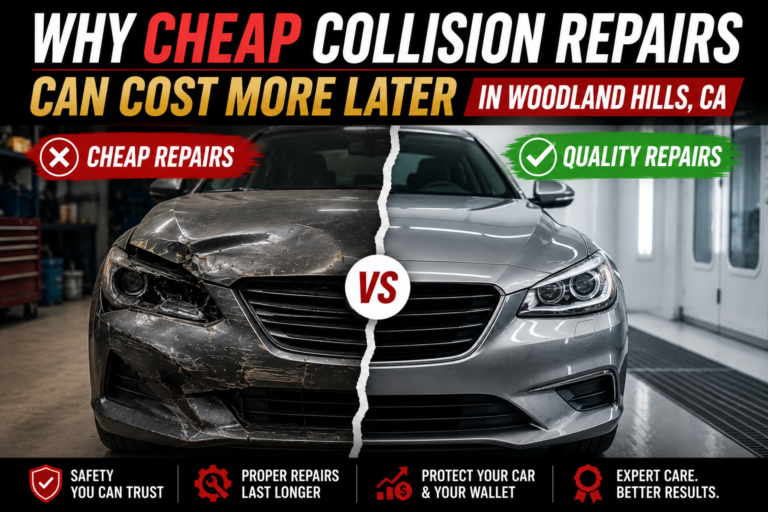
After an accident, many drivers immediately start comparing repair estimates. That is understandable. Collision repairs can feel unexpected and stressful, especially when dealing with insurance claims, rental vehicles, and daily transportation needs. However, choosing the cheapest repair option is not always the smartest long-term decision. For drivers researching collision repair in Woodland Hills, understanding the […]
Read Article →
After a vehicle is repaired following an accident, many drivers assume the process is complete the moment they pick up their keys. However, one of the most important steps in modern collision repair actually happens at the very end: the post-repair inspection. For drivers researching collision repair in Canoga Park, understanding the importance of post-repair […]
Read Article →Browse verified local providers in and around Calabasas who are equipped to handle everything from canyon-road scuffs to full OEM bumper replacements on luxury and late-model vehicles — including sensor recalibration and insurance coordination.