Hovee’s Auto Body & Paint helps drivers restore their vehicles after accidents, dents, and collision damage with professional auto body repair and painting services.


Compare dent repair options for San Fernando Valley vehicles — pro vs. DIY, PDR vs. traditional bodywork
Tarzana drivers dealing with parking lot dings, hail damage, or minor collision dents have real choices to weigh before committing to a repair method. Paintless dent repair (PDR) is often faster and less expensive than conventional bodywork, but it isn't the right fit for every dent or every vehicle. Understanding the difference helps you avoid overpaying — or under-repairing.
Dent repair covers a spectrum of techniques used to restore a vehicle's body panels after impact, indentation, or surface damage. In Tarzana's dense residential grid — where homes sit close together and street parking along Ventura and Reseda Boulevards is competitive — door dings from neighboring vehicles are among the most common complaints. The neighborhood's position in the San Fernando Valley also means vehicles parked outdoors are exposed to seasonal hail and windstorm debris that can leave clusters of small dents across hoods and roofs. Repair options range from paintless dent removal for shallow, paint-intact damage to full panel filling, sanding, and repainting for deeper creases. Choosing the right method depends on dent depth, location on the panel, and whether the paint surface has been broken.
Tarzana sits at roughly 991 feet in elevation at the foot of the Santa Monica Mountains, and vehicles here face a distinct set of hazards: tight parking near Ventura Boulevard retail corridors, falling debris from hillside-adjacent streets, and the occasional hailstorm that rolls through the Valley. Each scenario tends to produce a different type of dent — and each type responds better to a specific repair approach.
PDR is the go-to method when the dent is shallow and the paint is still intact. A technician uses specialized rods and picks to massage the metal back into shape from behind the panel — no filler, no paint, no extended shop time. For the door dings common in Tarzana’s crowded parking lots near the Tarzana Community and Cultural Center or the retail strips along Reseda Boulevard, PDR is typically the fastest and most cost-effective route.
When a dent involves a sharp crease, stretched metal, or chipped paint, traditional bodywork is the appropriate call. This process involves filling, sanding, priming, and repainting the affected panel. Vehicles that have been sideswiped on narrow Valley streets or struck by windblown branches near the hillside neighborhoods above Tarzana often require this more involved approach.
Hardware stores carry suction-cup dent pullers and glue-pull kits marketed to consumers. These work in limited circumstances — very shallow, centered dents on flat panels — but frequently leave high spots, ring marks, or fail entirely on character lines and curved panels common on newer vehicle designs. A professional assessment is low-risk and often free; it’s worth getting one before attempting a DIY fix that could complicate a later professional repair.
Tarzana’s mix of newer construction homes with garage parking and older properties where street parking is the norm means vehicle exposure varies significantly block to block. Learn more about local services available in Tarzana to find providers who know the neighborhood’s specific conditions.
Understanding when to call an expert can save you time, money and prevent bigger problems down the line.
Not every dent demands immediate attention, but some situations make prompt repair the smarter financial move. Tarzana’s commercial corridors and residential density create predictable dent scenarios worth recognizing.
Understanding the full scope of auto body services available helps you determine whether dent repair alone covers your situation or whether additional work — paint correction, frame inspection, or refinishing — is also warranted.
Hovee’s Auto Body & Paint helps drivers restore their vehicles after accidents, dents, and collision damage with professional auto body repair and painting services.
Signs You Need This Service
Visible Panel Indentation
A clear depression in a body panel — even a small one — is the obvious trigger for an assessment. In direct Southern California sunlight, shallow dents that are invisible in shade become clearly visible and affect the vehicle's appearance and resale value.
Paint Cracking or Chipping at the Dent Site
Cracked or missing paint at the center of a dent means bare metal is exposed to air and moisture. In Tarzana's dry summers punctuated by occasional wet winters, this is an active rust risk that makes prompt repair more urgent.
Multiple Small Dents After a Storm
A cluster of small, evenly distributed dents across a hood or roof is a signature of hail damage. This pattern is ideal for PDR when addressed before the paint begins to fail at impact points.
Door Edge Dings
Thin creases along the edges of doors are common in tight parking situations. These are among the harder dents to fully resolve with PDR due to their location, and a professional opinion helps set realistic expectations.
Pre-Sale or Pre-Return Inspection Finds
A buyer's inspection or lease-end evaluation that flags dents creates a defined, time-sensitive reason to seek repair — and knowing the cost beforehand gives you negotiating information.
Larger and deeper dents require more labor time and may require filler and paint rather than PDR alone. A small, shallow ding is significantly less involved than a crease spanning several inches.
Dents on flat, accessible panels like hoods are easier to reach and repair than those on door edges, near character lines, or close to structural reinforcements. Accessibility directly affects labor time.
When the paint is intact, PDR avoids color-matching costs entirely. Damaged or chipped paint requires priming, painting, and clear-coating, adding both materials and drying time to the job.
A single ding is priced differently than storm-pattern hail damage affecting twenty or more dents. Some shops offer per-panel pricing for hail work that differs from single-dent rates.
Aluminum panels, common on newer trucks and luxury vehicles, behave differently from steel under PDR tools and require technicians with specific training, which can affect pricing and shop selection.
Running a repair through an insurance claim introduces deductible considerations and potential rate effects; for minor damage, paying out of pocket may be the better financial outcome depending on your policy.
A technician examines the dent under directional lighting, checking size, depth, panel location, and paint integrity. This step determines whether PDR, conventional repair, or a combination is appropriate for your specific damage.
Based on the assessment, the shop recommends a repair approach and provides a written estimate. For insurance-covered work, this estimate is submitted to the carrier before work begins.
For PDR, a technician gains access to the back side of the panel — sometimes removing interior trim, tail lights, or other components — and positions specialized rods and picks at the dent location.
Working slowly from the outer edges of the dent inward, the technician applies controlled pressure to gradually return the metal to its original contour. This stage requires patience and is assessed under a reflection board or light throughout.
If paint was damaged, the repaired panel is sanded, primed, color-matched, painted, and clear-coated. Color matching is a skill-dependent step where shop quality makes a visible difference.
The completed repair is reviewed under lighting conditions that reveal any remaining imperfections before the vehicle is returned to the owner. A reputable shop addresses any concerns before considering the job closed.
This site is a directory of local service providers. Pricing, processes, timelines, and recommendations vary by company. Always confirm details directly with your chosen provider before proceeding.
Professional paint matching helps restore your vehicle’s appearance and protects long-term resale value after an accident. Modern paint systems are highly complex, especially with metallic and pearl finishes. Accurate paint blending and refinishing help ensure repaired panels match the surrounding factory finish properly.
Collision repair estimates can vary because each shop may inspect damage differently, use different labor rates, recommend different repair methods, or identify different levels of hidden damage. Parts selection, paint materials, structural repair needs, and insurance requirements can also affect pricing. A lower estimate is not always better if it leaves out important repairs or safety-related work.
Drivers should look for collision repair shops with strong reviews, experienced technicians, advanced repair equipment, insurance claim assistance, structural repair capabilities, and clear communication. Modern vehicles require specialized repair procedures and safety system calibrations, making professional experience extremely important after an accident.
Yes. California drivers generally have the legal right to choose their own collision repair shop after an accident. Insurance companies may recommend preferred repair facilities, but vehicle owners can select the shop they trust for repairs. Choosing an experienced collision repair facility helps ensure proper structural repairs, paint matching, and safety system calibration after an accident.
Yes. Even low-speed accidents can create hidden damage underneath visible body panels. Modern vehicles contain structural supports, sensors, brackets, and safety systems that may be affected during a collision. Professional inspections help identify hidden damage before it leads to larger safety or drivability issues later.
Collision repair timelines may change because hidden damage is often discovered after technicians disassemble the vehicle. Insurance approvals, parts availability, paint curing time, structural repairs, and safety system calibrations can also affect the repair schedule. Modern vehicles require more detailed repair procedures than older cars due to advanced technology and safety systems.
A collision repair estimate usually includes visible damage inspection, labor, replacement parts, paint materials, refinishing work, structural repairs, and sometimes diagnostic scans or safety system calibration. The first estimate may not include hidden damage because some issues are only discovered after vehicle disassembly. Supplemental estimates may be needed later.
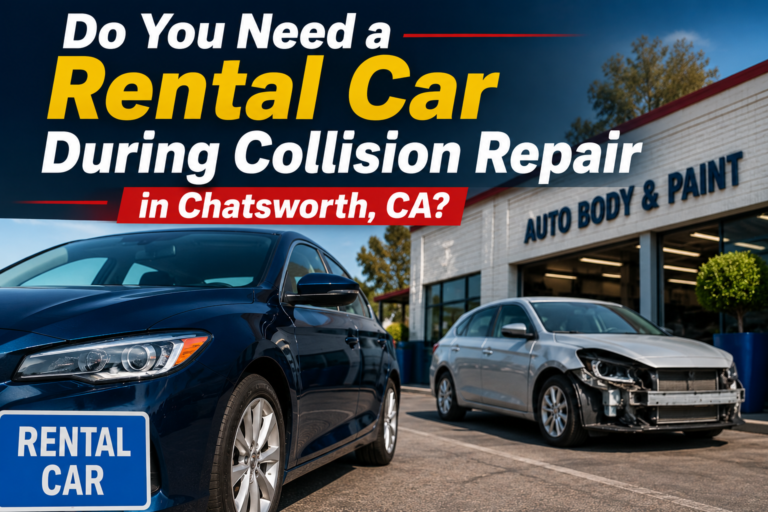
After an accident, many drivers focus immediately on the visible damage to their vehicle. But once repairs begin, another major question quickly comes up: “How am I going to get around while my car is in the shop?” For drivers researching collision repair in Chatsworth, understanding how rental cars work during the repair process can […]
Read Article →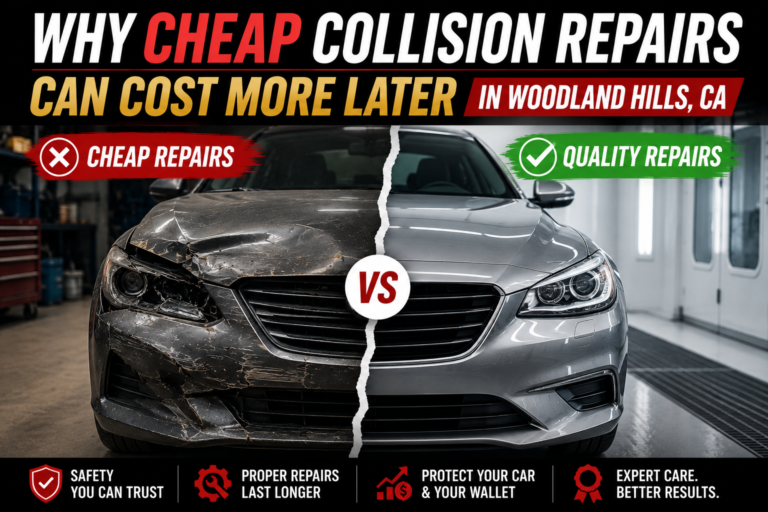
After an accident, many drivers immediately start comparing repair estimates. That is understandable. Collision repairs can feel unexpected and stressful, especially when dealing with insurance claims, rental vehicles, and daily transportation needs. However, choosing the cheapest repair option is not always the smartest long-term decision. For drivers researching collision repair in Woodland Hills, understanding the […]
Read Article →
After a vehicle is repaired following an accident, many drivers assume the process is complete the moment they pick up their keys. However, one of the most important steps in modern collision repair actually happens at the very end: the post-repair inspection. For drivers researching collision repair in Canoga Park, understanding the importance of post-repair […]
Read Article →Whether it's a parking lot ding from Ventura Boulevard or hail damage across your hood, connecting with an experienced local technician is the fastest way to understand your options and what the repair will realistically cost.