Quick Answer
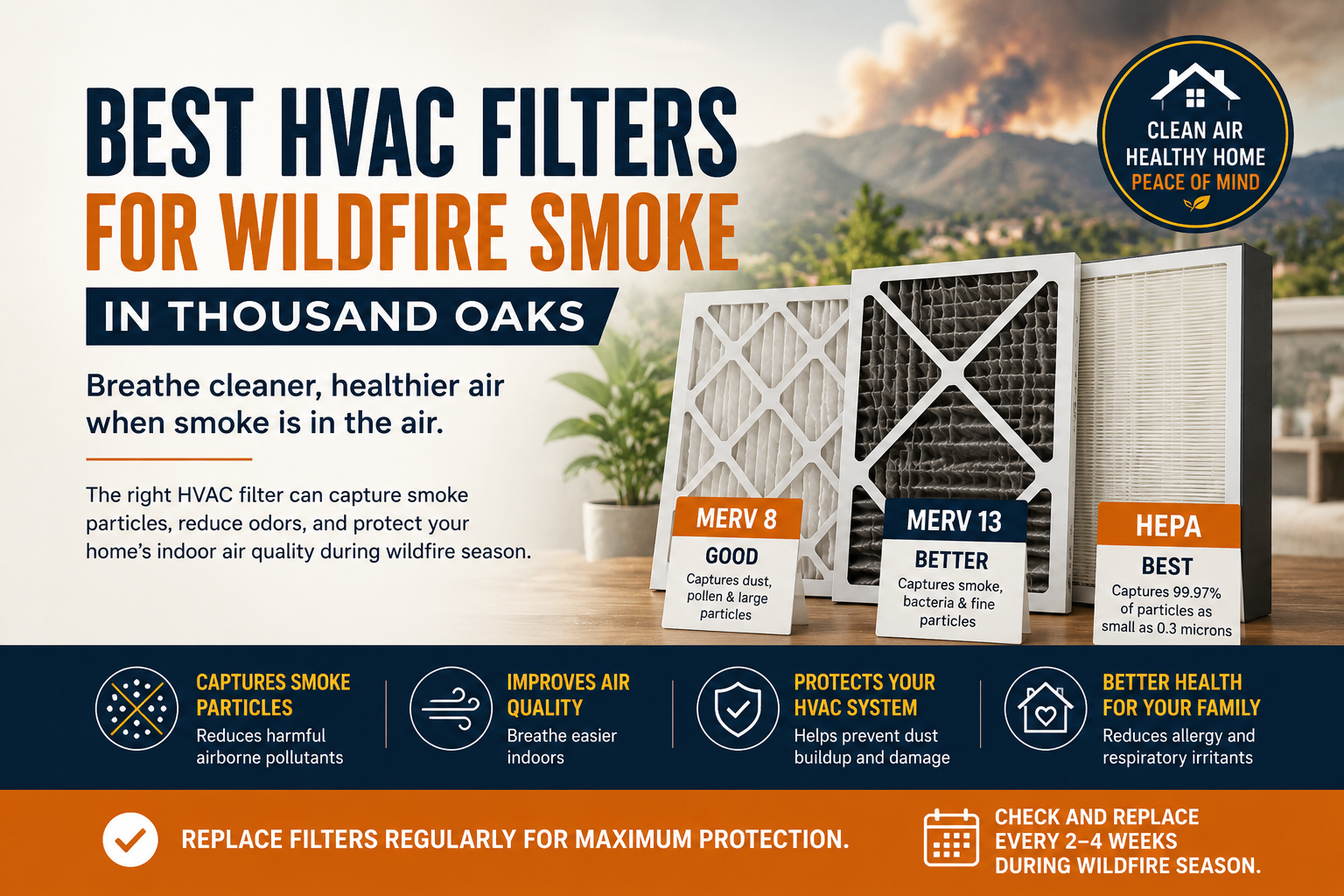
The best HVAC filters for wildfire smoke are usually higher-efficiency pleated filters rated around MERV 13, if your HVAC system can safely handle them. Wildfire smoke contains fine particles that standard low-efficiency filters may not capture well. Homeowners in Thousand Oaks should check their system compatibility before upgrading, replace filters more often during smoke events, and consider air purification support for stronger indoor air quality protection.
Wildfire smoke can travel far beyond the actual burn area. Even when flames are not close to Thousand Oaks, smoke from regional fires can drift into neighborhoods, settle around homes, and affect indoor air quality.
For many homeowners, the first reaction is to close the windows and stay indoors. That helps, but it may not be enough. Smoke particles can still enter through small gaps, ventilation systems, doors, attic spaces, and HVAC equipment. Once inside, those particles may continue circulating through the home.
Your HVAC filter becomes one of the most important lines of defense during wildfire season. But not all filters perform the same way. Some are designed mainly to protect equipment from dust. Others are designed to capture smaller airborne particles that affect indoor air quality.
If you live in Thousand Oaks and are concerned about wildfire smoke, choosing the right HVAC filter can make a noticeable difference. The goal is simple: reduce airborne smoke particles without damaging your HVAC system or restricting airflow too much.
Why HVAC Filters Matter During Wildfire Smoke Events
Wildfire smoke is made up of gases and fine particles from burning trees, brush, buildings, and other materials. One of the biggest health concerns is fine particulate matter, often called PM2.5. These particles are very small and can remain suspended in the air for long periods.
Because PM2.5 particles are so small, they can be inhaled deeply into the lungs. This is why wildfire smoke can irritate the eyes, throat, sinuses, and respiratory system. People with asthma, allergies, heart conditions, lung conditions, and other sensitivities may notice symptoms faster.
An HVAC filter helps capture particles as air passes through the system. During normal conditions, the filter may collect dust, lint, pollen, pet dander, and other household debris. During wildfire smoke conditions, the filter may also collect smoke particles and ash.
That extra workload matters. A filter that normally lasts several months may become dirty much faster during heavy smoke exposure.
What Is a MERV Rating?
MERV stands for Minimum Efficiency Reporting Value. It is a rating system used to describe how effectively an air filter captures particles of different sizes.
In general, the higher the MERV rating, the better the filter is at capturing smaller particles. But higher is not always automatically better for every HVAC system.
Higher-MERV filters are often denser. That means they may restrict airflow more than lower-rated filters. If your HVAC system is not designed for that level of resistance, it may have to work harder to move air through the filter.
This is why homeowners should not simply buy the highest-rated filter they can find without checking system compatibility.
MERV 8, MERV 11, and MERV 13: What Is the Difference?
Most residential homeowners will commonly see filters rated around MERV 8, MERV 11, or MERV 13. Each level offers a different balance of filtration and airflow.
MERV 8 Filters
MERV 8 filters are commonly used in many residential HVAC systems. They can help capture larger particles such as dust, lint, pollen, and some mold spores.
For everyday equipment protection, MERV 8 may be acceptable in many homes. However, wildfire smoke contains much smaller particles, so MERV 8 may not provide enough protection during heavy smoke events.
MERV 11 Filters
MERV 11 filters provide better filtration than MERV 8. They can capture a broader range of particles and may be a good middle-ground option for some homes.
For homeowners who want improved indoor air quality but are unsure whether their system can handle MERV 13, MERV 11 may be worth discussing with an HVAC professional.
MERV 13 Filters
MERV 13 filters are often recommended during wildfire smoke events because they are more effective at capturing finer airborne particles, including some smoke-related particles.
However, MERV 13 filters are not suitable for every HVAC system. Some older or undersized systems may experience airflow restriction if the filter is too dense.
Before upgrading to MERV 13, Thousand Oaks homeowners should confirm that their HVAC system can safely support it.
Is MERV 13 Always the Best Choice for Wildfire Smoke?
MERV 13 is often a strong option for wildfire smoke filtration, but it is not always the right choice for every home.
The best filter depends on several factors:
- Your HVAC system design
- Filter slot size
- Blower motor strength
- Ductwork condition
- Existing airflow performance
- How often the system runs
- The severity of smoke exposure
If a filter is too restrictive, it may reduce airflow. Reduced airflow can make the HVAC system less efficient and may increase strain on equipment.
That is why the best approach is not just “buy the highest MERV filter.” The better approach is “use the highest-efficiency filter your system can safely handle.”
How Often Should You Replace HVAC Filters During Wildfire Season?
During normal conditions, many filters are replaced every one to three months, depending on the home, filter type, pets, dust levels, and system usage.
During wildfire smoke events, that schedule may change quickly.
If smoke is heavy, filters can become dirty much faster. Some homeowners may need to inspect filters every few days during severe smoke conditions. Others may need replacement after a few weeks rather than a few months.
Signs your filter may need replacement include:
- Gray or black discoloration
- Visible ash or debris
- Reduced airflow from vents
- More dust inside the home
- Smoke odors when the HVAC runs
- Unusual system noise
- Longer cooling or heating cycles
If the filter looks dirty after a wildfire smoke event, replacing it is usually a smart first step.
Can a Better Filter Remove Smoke Odor?
A better HVAC filter can help reduce airborne particles, but smoke odor is more complicated.
Smoke odor can come from tiny particles, but it can also come from gases and residue that cling to surfaces. Standard pleated filters are mainly designed for particles, not odor gases.
If your home still smells like smoke after replacing the filter, the odor may be coming from:
- Duct surfaces
- Dirty coils
- Blower components
- Insulation
- Carpet and upholstery
- Curtains and fabrics
- Walls and ceilings
In some cases, activated carbon filters or dedicated air purification systems may help reduce odors. However, homeowners should avoid adding restrictive filter layers without checking airflow requirements.
Should You Use HEPA Filters in Your HVAC System?
HEPA filters are known for capturing extremely small particles. They are commonly used in portable air purifiers and specialized filtration systems.
However, standard residential HVAC systems are usually not designed to accept true HEPA filters directly in the regular filter slot. A true HEPA filter may be too restrictive for many central HVAC systems unless the system is specifically designed for it.
For many homeowners, a portable HEPA air purifier may be a better solution for bedrooms, living rooms, or other high-use areas during wildfire season.
Whole-home air purification systems may also be available, depending on your HVAC setup.
Tips for Using Your HVAC System During Wildfire Smoke
Choosing the right filter is important, but it is only one part of a complete indoor air quality strategy.
Keep Windows and Doors Closed
During heavy smoke conditions, keep windows and exterior doors closed as much as possible to reduce smoke infiltration.
Use Recirculation Mode
If your HVAC system has a setting that allows indoor air recirculation, use it during smoke events. This helps avoid pulling in smoky outdoor air.
Inspect the Filter Frequently
Do not rely only on the normal replacement schedule during wildfire smoke. Check the filter visually.
Avoid Creating More Indoor Particles
During smoke events, avoid burning candles, smoking indoors, frying foods heavily, or using fireplaces. These activities can make indoor air quality worse.
Use Portable Air Purifiers
Portable HEPA air purifiers can provide additional support in rooms where your family spends the most time.
Schedule an HVAC Inspection
If airflow seems weak, filters are clogging quickly, or smoke odors continue, an HVAC inspection can help identify the issue.
Why Thousand Oaks Homes May Need Extra Indoor Air Quality Support
Thousand Oaks is surrounded by hills, open space, and nearby brush areas. During Southern California fire season, smoke from regional wildfires can settle into local neighborhoods even when the fire itself is not directly nearby.
Homes near open space, canyons, or wind-exposed areas may experience more smoke intrusion. Older homes may also have more air leakage around doors, windows, attic spaces, and ductwork.
That makes HVAC filtration and indoor air quality planning especially important.
A good filter can help. But for many homes, the strongest solution combines several steps:
- Proper filter selection
- Frequent filter replacement
- HVAC inspection
- Duct evaluation
- Air sealing improvements
- Portable or whole-home air purification
When to Call an HVAC Professional
Some filter changes are simple enough for homeowners to handle. But professional help is useful when smoke problems continue or when you are unsure whether your system can handle a filter upgrade.
Call an HVAC professional if:
- Your home smells like smoke when the HVAC runs
- Filters turn dark quickly after replacement
- Airflow feels weaker than usual
- You are considering a MERV 13 upgrade
- You have older HVAC equipment
- You suspect duct leakage
- Your family has respiratory sensitivities
An inspection can help determine whether the issue is filtration, duct contamination, airflow restriction, equipment condition, or another indoor air quality concern.
Final Thoughts
The best HVAC filter for wildfire smoke is not the same for every home. For many Thousand Oaks homeowners, a properly fitted MERV 13 filter may offer stronger protection against fine smoke particles, but system compatibility matters.
A filter that is too restrictive can create airflow problems. A filter that is too weak may not capture enough smoke particles. The right balance is key.
During wildfire season, inspect filters more often, keep outdoor smoke from entering the home, use recirculation when appropriate, and consider air purification support for high-use rooms.
If smoke odors linger or airflow changes, schedule a professional HVAC inspection. Clean air starts with a system that is properly maintained, properly filtered, and ready for Southern California wildfire conditions.
Frequently Asked Questions
What MERV filter is best for wildfire smoke?
MERV 13 is often recommended for wildfire smoke when the HVAC system can safely support it. Some systems may require a lower rating to preserve airflow.
Can I put a HEPA filter in my home HVAC system?
Most standard residential HVAC systems are not designed for true HEPA filters in the regular filter slot. Portable HEPA air purifiers are often a better option.
How often should I change my HVAC filter during wildfire smoke?
During heavy smoke events, inspect filters more frequently. Some filters may need replacement much sooner than the normal one-to-three-month schedule.
Will a better HVAC filter remove smoke smell?
A better filter can reduce airborne particles, but smoke odor may also come from gases and residue on surfaces, ducts, filters, or HVAC components.
Is MERV 13 safe for all HVAC systems?
No. Some systems may not handle MERV 13 filters well because of airflow restriction. An HVAC professional can confirm compatibility.
Should I run my HVAC during wildfire smoke?
Running the HVAC system with proper filtration and recirculation may help filter indoor air, but dirty filters or outdoor air intake can make conditions worse.